Helping Couples Move from Conflict to Connection
Because beneath every recurring argument is a deeper need to feel understood, valued, and connected. Every relationship faces challenges. When the same arguments keep repeating, communication breaks down, or trust has been damaged, it can be difficult to know how to move forward alone.
Couples therapy provides a space to slow down, understand what’s happening beneath the conflict, and learn new ways of relating to one another. While many couples focus on the argument itself, the deeper issue is often found in the patterns and emotional experiences driving the conflict.
Using the Gottman Method I help couples identify these underlying dynamics, strengthen communication, deepen emotional connection, rebuild trust, and develop practical skills that support lasting change.
Whether you feel disconnected, caught in recurring conflict, or uncertain about the future of your relationship, meaningful change is possible. I work with couples from all backgrounds, including those who wish to integrate their Christian faith, with a focus on helping partners move from conflict to connection and become a stronger team together.
The Couples Therapy Process
Joint Relationship Assessment
(2 Hours)
The first session is an opportunity for us to begin understanding your relationship story and the challenges you are currently facing. Together, we will explore:
- How you met and the history of your relationship.
- The strengths and resources within your relationship.
- The concerns that have brought you to counselling.
- Patterns of communication and conflict.
- Important life events and transitions.
- Your hopes and goals for therapy.
This session provides a safe and supportive space for both partners to share their perspectives and begin identifying the patterns that may be contributing to difficulties within the relationship.
- Following the individual sessions, each partner will be invited to complete the Gottman Relationship Checkup. This comprehensive assessment provides valuable insight into the strengths of the relationship, areas of concern, and opportunities for growth
Individual Sessions
(1 hour)
The second session provides an opportunity for each partner to individually explore their personal history and experiences in greater depth. Areas we may discuss include:
- Family-of-origin experiences.
- Significant relationships and life events.
- Attachment patterns and emotional needs.
- Individual strengths and areas for growth.
Feedback and Goal Setting
(2 Hours)
In the feedback session, we review the information gathered from our conversations and the Gottman Relationship Checkup. Together, we identify the key themes influencing your relationship and develop a personalised plan for therapy. This session includes:
- Feedback on your relationship strengths and challenges.
- Identification of communication and conflict patterns.
- Discussion of therapeutic goals.
- Development of a treatment plan tailored to your relationship.
From this point forward, therapy sessions are guided by your goals and developing practical skills to support lasting change. While the Gottman Method provides a structured framework for assessment and intervention, every couple’s journey is unique. Therapy is tailored to your individual relationship, needs, and goals, integrating evidence-based approaches such as attachment theory and neuroscience-informed practice to support meaningful and lasting change.
A Safe and Supportive Environment
Throughout your journey, you can expect to be treated with respect, care, and professionalism. Our aim is to create a safe, welcoming space where you feel seen, heard, and empowered.
Discernment Counselling
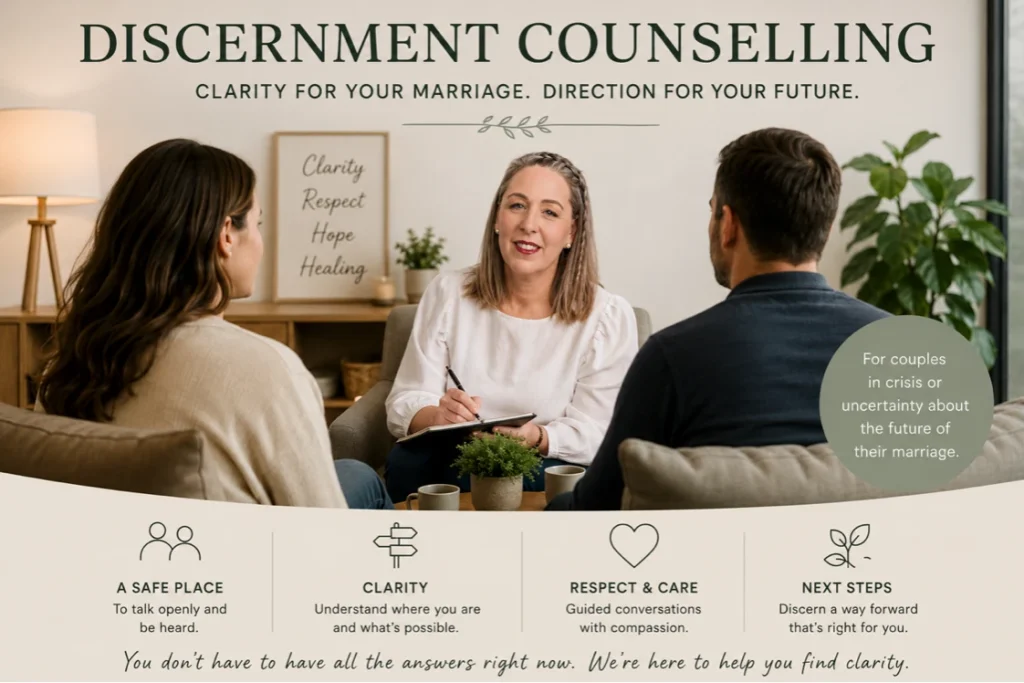
Discernment counselling is a short-term process for couples on the brink of divorce who have a “mixed agenda,” meaning one partner wants to save the marriage and the other is leaning out. It helps partners choose among three paths rather than immediately trying to fix the relationship: staying as-is, separating or divorcing, or committing to a six-month course of Gottman’s couples therapy. Research shows that 36% of couples seeking therapy fall into this category, yet traditional therapy assumes both partners are committed to working on the relationship. The therapist remains neutral, not pushing for either outcome. Instead, they help each of you understand your role in the marital problems and explore what each path forward might look like.
Who can benefit from Discernment Counselling
- Couples where one partner wants to end the relationship while the other wants to save it
- Partners experiencing uncertainty about whether to stay or leave
- Couples who have tried traditional therapy without success
- Those considering divorce but wanting to ensure they've explored all options
- Parents concerned about the impact of divorce on their children
How the Process Works
- Short-term format: Lasts a maximum of one to five sessions
- Individual focus: Combines joint discussions with separate, one-on-one conversations between the counsellor and each partner.
- Self-exploration: Encourages each person to look at their own contribution to the marriage problems instead of blaming.
- Neutral stance: The therapist does not push for divorce or reconciliation.
- Purpose: Decision-making clarity, not problem-solving
- Success: helps couples make intentional decisions
The Three Possible Paths
- Path 1: Keep things as they are (status quo).
- Path 2: Move forward with separation or divorce.
- Path 3: Commit to six months of intensive couples therapy with divorce put completely off the table
Key Questions Explored in Session
During the initial session, therapists typically explore four core areas:
- What happened in the relationship that brought the couple to consider ending it?
- What efforts have been made to improve or fix the relationship?
- How do children factor into decisions about the relationship's future?
- What were the best times experienced together as a couple?
Key Questions Explored in Session
Discernment counselling sessions focus on what each partner can learn about themselves and their relationship dynamics. The process typically involves:
- Brief joint meetings at the beginning and end of each session
- Individual conversations with each partner comprising the majority of session time
- Preparation of each person to share insights with their partner
- Summary and planning for potential next steps
How Discernment Counselling Works
The structure of discernment counselling is carefully designed to reduce conflict while maximising clarity. The goal is to help each spouse gain a deeper understanding of what happened to the marriage and their own contributions to the problems.
Individual Focus Within a Couples Context
Unlike traditional couples therapy where partners spend most of their time together, discernment counselling emphasises individual conversations. This approach allows each partner to:
- Express their true feelings without fear of escalating conflict
- Explore their ambivalence openly
- Consider their own contributions to relationship problems
- Gain clarity about their desires and concerns
Building Understanding and Empathy
Through structured conversations, partners develop deeper insight into:
- Their own patterns and behaviours that contributed to current problems
- Their partner's experience and perspective
- The relationship dynamics that led to the current crisis
- Potential for change and growth
Enhanced Therapy Outcomes
When couples choose to pursue therapy after discernment counselling, they often experience better outcomes because they:
- Enter therapy with greater commitment
- Have already identified core relationship issues
- Understand their individual contributions to problems
- Feel more hopeful about the possibility of change
A Safe and Supportive Environment
Throughout your journey, you can expect to be treated with respect, care, and professionalism. Our aim is to create a safe, welcoming space where you feel seen, heard, and empowered.


FAQ
How long does discernment counselling typically last?
Discernment counselling is designed as a brief intervention, typically lasting between one and five sessions. Each session usually runs 1.5 to 2 hours, with most of the time spent in individual conversations with each partner.
Is discernment counselling the same as marriage counselling?
No, discernment counselling differs significantly from traditional marriage counselling. While marriage counselling aims to improve the relationship, discernment counselling focuses on helping couples decide whether to work on the relationship, separate, or maintain the status quo.
Can discernment counselling save my marriage?
Discernment counselling doesn’t aim to save marriages directly. Instead, it helps couples make informed decisions about their future. About half of couples who complete the process choose to enter marriage counselling with renewed commitment and clarity.
Fees
In-Person & Online
Discernment Counselling
- Initial session (2 hrs): $480
- Discernment Follow-up: $350
- Afterpay available
Take the first step toward healing
Schedule your initial consultation today
Together, we’ll explore your unique journey and discover how our specialised approach can support and guide you toward true wholeness.

Katherine Vines
Drawing on years of experience in nursing care, I have embraced the calling to support not just the body, but also the mind and soul. My heart is to offer a space of compassion, truth, and hope where healing and restoration can begin.
Read More
My counselling approach is Christ-centred and trauma-informed, drawing on evidence-based therapies such as Cognitive Behavioural Therapy (CBT), person-centred, psychodynamic, and attachment-based models. I tailor each session to reflect your individual journey, integrating clinical wisdom with spiritual understanding. I believe that true healing takes place when we tend to the whole person – mind, body, and spirit – reflecting the triune nature of our being, created in the image of God. Like a three-legged stool, each part must be cared for and strengthened; if even one leg is neglected or broken, the whole structure becomes unstable. In tending to each part, we build a strong and steady foundation – one that supports resilience, wholeness, and a life grounded in Christ. Whether you’re carrying emotional burdens, working through past experiences, or exploring questions of faith, I offer a safe and compassionate environment where you are heard, supported, and encouraged toward meaningful growth and healing.
- Post Gradaute Diploma in Counselling (Christian)
- Certificate IV in Training & Assessment.
- Post Graduate Certificate in Emergency Nursing
- Master of Nursing